I’m a sucker for reading about people’s processes and progress. I gravitate towards blog posts and dev logs (development logs) where individuals document what they’ve been building and how. One of my favourite books in this genre is the Prince of Persia book from Jordan Mechner, which is just the journals he kept during the creation of the game, published. It spans over a few years and isn’t daily, but I find it fascinating to see his progress and momentum, as well as the inner dialogue he documents. I find it inspiring and motivating.
In the meantime, I’ve also struggled to wrap my head around my own approach to notetaking. I’m good at the brain dump, in-the-moment, scratchpad approach to notes. I externalize my thought process in very throwaway notes. I rarely keep anything long-term except by happenstance. I go back and forth between paper and digital. I even built myself an app that better mirrored my approach to notetaking . But of course I am always looking for ways to improve, and perhaps something will stick.
“The humblest field record is always an act of translation. Whatever is recorded…all have to be processed by human senses and translated into words, numbers, sketches, photographs, or any one of the many other communicative conventions or devices that serve to inform other humans.”
Jonathan Kingdon
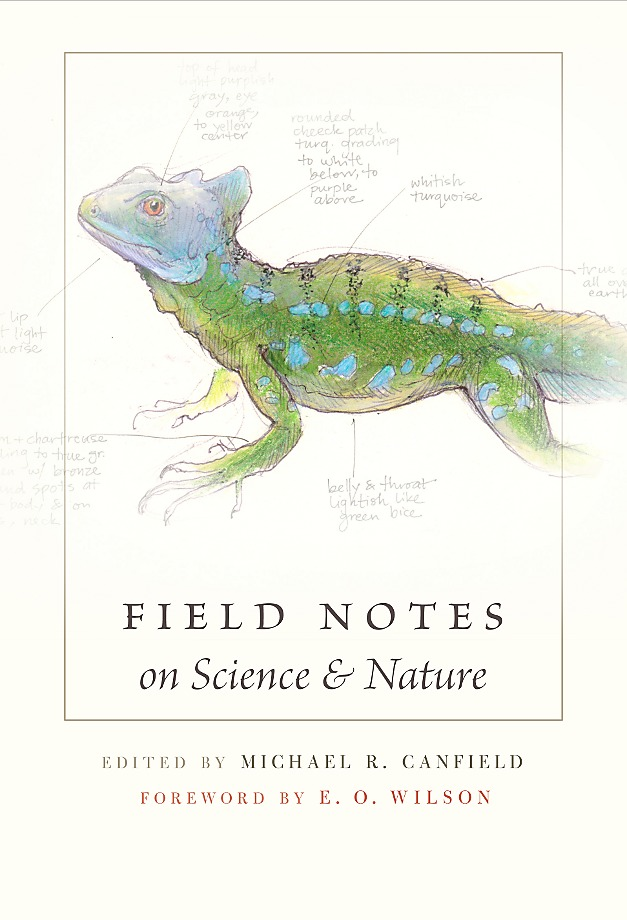
I just finished reading Field Notes on Science and Nature which contains a series of essays by field scientists. Most of these scientists work towards publishing papers, books, and reports. Its focus is more on both the philosophical and tactical side of field studies, there were a handful of things I took away.
1. Don’t just highlight or quote things
Use friction as a source of reflection. I’m guilty of aggressively highlighting in Readwise and on the Kindle to the point that I sometimes question why I even saved something. I’ve realized they even adding a word or two in the moment about why I chose to highlight that passage can go a long way for making that experience more valuable. Was it the phrasing? A relationship to a different idea? Did it spark something else? This helps add context and hopefully filters for what’s worth highlighting.
2. Use a project-specific notebook
This is something I’ve toyed with and then never really stuck to because of how and when I get my ideas – I would only ever carry a single notebook on me so inherently different ideas and projects would get mashed up. I like the idea of having project-specific notebooks to better capture both the sequence of ideas and work, but keep things more centrally organized and allow you to have more structured content within the notebook.
One of my “weak points” when it comes to notebooks has been my scarcity mindset when it comes to pages (lol). I didn’t want to waste any whitespace, so each page would get used until it was filled. If instead I tried to optimize for future use and structure, I would start a new page each day so I could better understand when ideas are happening. Time is such an important piece of context for piecing together your work. So my key change from this will be: use project-specific notebooks. How this fits into my workflow will be a bit of #3.
This also lets me indulge in buying more notebooks. Now to pick a model that I’ll use for all projects…
3. Your notes are for you; they don’t need to be publish-ready
A lot of the writers in the book talk about a system that I would summarize as:
Field Notes/Scratchpad > Project Notebook > PublicationFor me this would start with the scratchpad brain-dump approach I currently do, pure chaos and no organization. Then a step of transcribing notes into a project-specific notebook. This helps you revisit the flow of ideas that came into the original scratchpad and filter those worth keeping.
I find some notes are throwaways, used only for thinking through things in the moment or sketching something out but not worth preserving or re-visiting. Transcribing your notes is a way of processing & structuring them into something a bit more cohesive.
“Journals are parallel records to my notebooks that keep an account of my fieldwork in narrative form.”
Roger Kitching
Lastly, if you want, you can publish (post) something based on your notes. This is when you give things the full narrative treatment and piece together multiple days or weeks worth of notes into something bigger. I’m going to test this flow and see how well it works for me.
4. Notebooks should be multi-modal
For me that means mostly adding sketches since I prefer paper (vs having photos in there), but could also include other types of data beyond visual. Perhaps audio, specific data points like the weather or your location. Depending on what you want to be able to reconstruct in the future, quickly jotting down these small details can add more colour to the story.
“No matter how many words you write to describe a fossil locality, you can’t beat an actual photo, taken on the spot, annotated in pen, and pasted in your notebook.”
Anna K. Behrensmeyer
5. To sketch is to see.
One way to augment notes, and for me, think better, is to attempt to sketch what you’re thinking. A lot has been written about the power of drawing, but what I’ve found with diagrams (different than art artist’s rendition), is that understanding what you intend to communicate is often far harder than figuring out how. Once it’s clear what you want to convey, your options tend to present themselves.
“In creating an image (no matter how skillfully), the lines and tones on the paper provide ongoing feedback as to what you have closely observed and what you have not.”
Jenny Keller
But this part is hard! Much like choosing the right words, it’s easy to think drawing something is easy. But what are you trying to say? Are you highlighting something in particular? Drawing the system as a whole?
“The comparison of forms raises questions and drawing can be employed as a wordless questioning of form; the pencil seeks to extract from the complex whole some limited coherent pattern that our eyes and mind can grasp. The probing pencil is like the dissecting scalpel, seeking to expose relevant structures that may not be immediately obvious and are certainly hidden from the shadowy world of the camera lens.”
Jonathan Kingdon
Framing a photo (choosing what goes in the frame) is an active choice as to what to include and omit. Drawing takes this to the extreme. Since you have to actively draw each element, a viewer expects it to have a purpose. Including everything can be very confusing because then someone doesn’t know where to look or what to take away. I have a bunch of thoughts on this, but I’ll save that for a future post.
6. Images are more precise than words
Words are often imprecise ways to describe something. While some people can use very evocative and descriptive language, the rest of us plebs struggle with this. If a group of people read a single passage describing a scene, or a donut, or a feeling, each individual will imagine something different.
“In creating an image (no matter how skillfully), the lines and tones on the paper provide ongoing feedback as to what you have closely observed and what you have not.”
Jenny Keller
A photo or drawing is more precise. It narrows the possibilities of what you see to around one. You can’t hide behind the generalities of words. You must show in a very specific way, eliminating many paths of misunderstanding. It also means you must have the clarity to draw it in such a way. This can be both a pro and a con.
“As an illustrator, though, I need to find out more. ‘Do you mean wavy like a potato chip, or wavy like a washboard? And was that one cupped like a contact lens, or cupped like a cereal bowl, or cupped like the ballooned-out dome of a jellyfish?’ My questions were playful but sincere–an illustration can only show specific shapes, not generalities”
Jenny Keller
In some scenarios, you want to let people interpret your writing however they choose. In others, you want to paint a specific picture. It’s like how when we read a novel, everyone has their own mental depiction of the characters. But as soon as the movie trailer comes out, every possibility collapses into one.
7. Choose the system that works best for you.
One thing I’ve done a better job internalizing more recently is that in all things, the best system for you is the one you stick with. If rules on notetaking means you don’t take notes or it’s too high friction, then get rid of the rules! Just like the best diet or workout is the one you follow, the best system is the one that works for you.
“The lasting relevance, or “half-life,” of a set of field notes depends both on the quality of the project–the scope, goals, and basic information–and on the way the observations and ideas are actually recorded.”
Anna K. Behrensmeyer
A good way to learn what it is you are looking for in notes is to spend time with other people’s notebooks. This can help you understand what you do and don’t like. I’m using this as a rationalization for why I spend so much time reading about other’s processes instead of spending more time on my own. Everyone else seems more structured – but I think this is partly an illusion. As I allude to in #3, the unstructured notes are for you. Just as reading someone’s articles can lead you to believe they are always such a clear thinker, you are only seeing the output. Writing and note taking are a means of wrangling the mess and chaos of your brain and attempting to shape it into something coherent.
I knew I would enjoy this book because of how I like to nerd out on process, but I didn’t expect to be able to have some specific things I wanted to try.